Industrial Vending Solutions for Manufacturing Plants & Warehouses
Smart Café Micromarkets Transform Your Employee Break Room
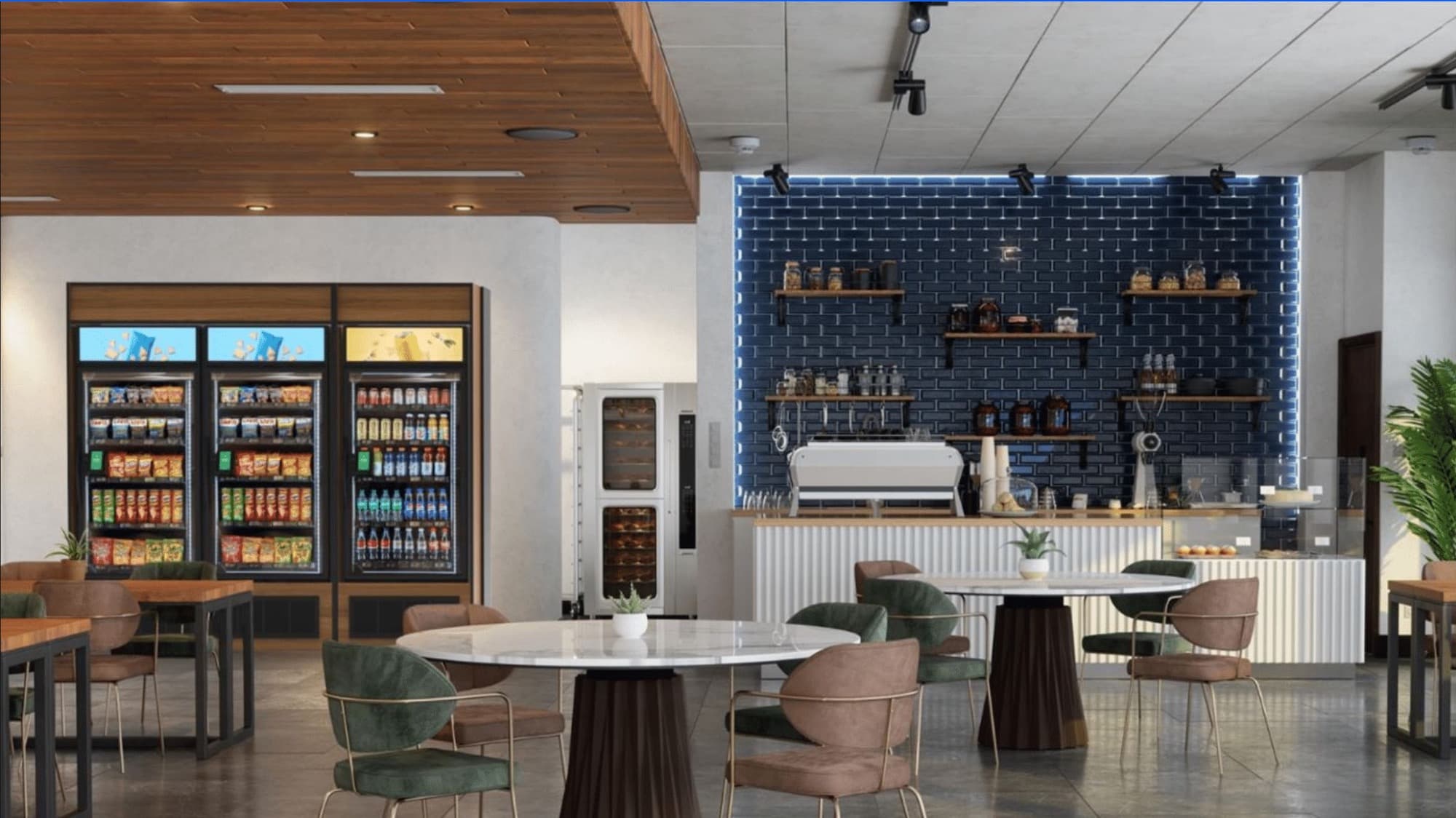
Raptor Vending brings San Antonio smart vending and a micro market to manufacturing plants and warehouses, with grab-and-go gourmet meals on every shift. A traditional vending machine can’t keep up with the demands of today’s industrial workforce. Our Smart Café micromarket solution brings restaurant-quality meals, fresh snacks, and beverages directly to your manufacturing facility or warehouse — creating a modern employee break room that boosts productivity, morale, and retention. Through our partnership with Southerleigh Hospitality Group, we deliver chef-prepared meals alongside grab-and-go options, all managed seamlessly by our team.

Why Raptor Vending Is Fit to Power Texas’ Leading Manufacturing Facilities
Keep Your Workforce Fueled Without Leaving the Facility
Chef-Crafted Hot Meals for Every Shift
Offer your employees restaurant-quality breakfasts, lunches, and dinners prepared by Southerleigh Hospitality Group chefs, available 24/7 for all shifts.
Smart Fridge™ + Smart Cooker™ Technology
Fresh meals stay perfectly chilled until employees are ready to heat them in our advanced smart cooking system — no cafeteria staff required.
Industrial-Strength Reliability
Built to withstand high-traffic industrial environments with minimal downtime and maximum durability.
Contactless Payment for Safety
Workers can quickly pay with tap-to-pay cards, Apple Pay, or Google Pay — reducing contact points and speeding up break times.
Complete Turnkey Service
From installation to daily restocking, equipment maintenance, and 24/7 tech support — we handle everything so you can focus on production.
Data-Driven Inventory Management
Our AI-powered system tracks consumption patterns across shifts, ensuring popular items stay stocked while reducing waste.
The problem is the hours, not the vending machine
A plant running two or three shifts has a food problem the day shift never sees. The canteen, if there is one, serves the middle of the day. After that the options are a bank of machines selling packets, a microwave with a queue at break, and whatever is open on the drive home.
The cabinet does not fix that by being a better vending machine. It fixes it by not needing anyone to be there. It is locked, it opens on a card or a phone tap, and it holds chef-made entrées from Southerleigh Hospitality Group chilled and sealed until somebody takes one. The Smart Cooker™ beside it heats a meal by induction in under 7 minutes, three at a time per tower, which is sized for a break rather than for one person at a time.
For a plant that means third shift eats the same food as first. Not a different, worse version of it at a different hour: the same rotation of 14 entrées, restocked against what the site is actually taking.
The other thing it removes is the microwave queue. A break is a fixed length, and a single microwave reheating one container at a time spends most of that break being waited for. Three induction pods running at once turn the same break back into time spent eating.
None of that requires the site to run anything. There is no till to reconcile, no stock to count, no rota to cover and nobody to train, which is the usual reason a good idea about plant catering never survives contact with the operations manager.
Three steps, inside a break
Tap a card or a phone
No app, no account, nothing deducted from pay. Nothing is charged until the door shuts.
Take what you want
Open the door, take as much as you like, put back what you do not want. Cameras inside track what left the shelf and the charge matches it.
Heat it in under 7 minutes
Induction rather than a microwave, in the sealed pod the meal was cooked in, so the break room does not end up smelling of somebody else's lunch.
What the site provides, and what it does not
A dedicated 30A, 120V circuit
For the Smart Cooker™. The Smart Fridge™ runs on a regular 120V outlet and needs no circuit of its own.
A network connection
WiFi or a hardwired Ethernet cable, one port, which Raptor splits to the rest of the equipment. Cellular is a backup rather than the main link.
About 50 square feet in a break room
The cabinets sit in the conditioned part of the building, not on the floor. No plumbing, no hood, no construction and no permit for a kitchen that is not being built.
No fee of any kind
Raptor charges no placement fees and no minimums, and never invoices the site for the program. Restocking, cleaning, repairs and the menu are Raptor's.
Running unattended, in a building nobody is watching at 3am
The cold side is monitored. The Smart Fridge™ holds 32 to 38°F, its temperature is tracked around the clock, and it raises an alert if it drifts, so a refrigeration fault on a Sunday night becomes a message to Raptor rather than a discovery at Monday's shift change. Anything past its freshness window cannot be sold at all: the cabinet will not release it.
The stock is monitored too. Every cabinet reports what it holds, so restocking is scheduled against real consumption rather than a fixed route, which matters at a site where second shift eats completely differently from first. Most faults are fixed remotely before anyone notices, and an employee who needs to report something uses the code on the cabinet, which opens the help page with the site already filled in, at any hour.
The site gets a usage report every month: transactions, popular items, usage patterns and restock performance. Broken out by hour it is also the clearest picture most plants have had of what their off-shifts actually eat.
The agreement
Infrastructure agreements run five years, and either party can exit if a problem is not cured within 30 days. Before that there is a 120-day trial with the full installation rather than a demonstration unit, which for a multi-shift site is the only way to see all three shifts' behavior.
Why this is a retention question before it is a food question
Plants compete for the same people as every other plant within a reasonable drive, and the things that differentiate them are mostly money, which is expensive, or conditions, which are not always in anyone's gift. Food is one of the few levers that sits in between.
The argument is not that a cabinet keeps anyone in a job. It is narrower and more honest than that: a site that feeds its night shift properly is visibly treating its night shift the same as its day shift, and people notice which sites do that. A break room where third shift gets a hot meal and first shift gets a canteen is a different place to work from one where third shift gets a machine full of chips.
It is also one of the few amenities that costs the site nothing to run. There is no subsidy to defend at budget, no headcount, and no contract minimum to hit in a quiet month, because Raptor is not invoicing the site at all. What the plant spends is the electrical work at install, once.
Where it does not fit
Worth saying plainly. A site with a staffed canteen running across all shifts already solves this, and a cabinet beside it is redundant rather than complementary. A very small site with few people on nights may not generate enough demand to keep a chilled rotation moving, and stale stock is worse than no stock.
The case where it clearly works is the common one: a few hundred people, more than one shift, a canteen that covers the middle of the day, and nothing at all after it closes.
Frequently Asked Questions
Smart Café for plants and warehouses
What food service works for a plant running multiple shifts?
One that does not depend on anyone being rostered to serve it. The cabinet is locked and opens on a card or phone tap, so second and third shift get the same food as first, with no canteen hours to work around.
Meals are chef-made by Southerleigh Hospitality Group, held chilled and sealed, and heated in under 7 minutes by the Smart Cooker™.
Can night shift get a hot meal?
Yes, and this is usually the reason a plant installs one. At three in the morning the alternatives are a microwave, a machine full of packets, or a drive.
The Smart Cooker™ heats a sealed entrée by induction in under 7 minutes and each tower does three at once, so a shift change does not turn into a queue in the break room.
What does it cost the plant?
Nothing to Raptor. No placement fees, no minimums, and the plant is never invoiced for the program.
The plant pays for its own electrical and network work: a dedicated 30A, 120V circuit for the Smart Cooker™ and a network connection. Employees pay for what they take, and a chef-made entrée is $12.50.
What does the plant have to provide?
About 50 square feet, a dedicated 30A, 120V circuit for the Smart Cooker™, and either WiFi or a hardwired Ethernet cable. One port is enough; Raptor splits it to the rest of the equipment.
The Smart Fridge™ runs on a regular 120V outlet. No plumbing, no hood and no construction, which matters in a building where changing anything usually means a permit.
Who cooks the meals?
Southerleigh Hospitality Group. Their restaurant, Southerleigh Fine Food & Brewery, has held a Michelin Bib Gourmand three years in a row. The meal brand is Sense of Occasion.
There are 14 entrées in rotation, with meat-free options and ingredients and allergens published for each, plus snacks and drinks, and the menu rotates.
How do employees pay?
By tapping a card or a phone on the cabinet. There is no app to download and no account to open, and nothing is deducted from pay.
Nothing is charged until the door closes, and the charge matches what was taken.
Does it work in a warehouse or plant environment?
The cabinets go in a break room or canteen rather than on the floor, so they sit in the conditioned part of the building like any other appliance. They need the circuit, the network and the floor space, and nothing else from the site.
Refrigeration is monitored around the clock with alerts, so a temperature problem in a building nobody is watching overnight becomes a message to Raptor rather than a discovery at shift change.
How long does installation take?
Four to six weeks from a signed agreement, most of it the plant's own electrical work. Once the circuit and network connection are in and tested, the cabinets go in within two to four hours.
It starts with a 30 to 45 minute assessment of electrical capacity, the network and placement, and a written proposal within five days.
Schedule a Tasting
Experience the Raptor Vending difference firsthand. Schedule a free product tasting at your property and explore the variety of hot meal menu items from Southerleigh. We’ll bring a curated selection directly to you, so you and your team can sample what sets our smart vending machines apart — no pressure, no commitment.
- Great for larger groups of 10 or more
- Choose up to (4) menu options
- We bring the food to you!
Calendar not loading? Open it in a new page or call (385) 438-6325.